Posts

Showing posts with the label Mobility

Does anybody know what Lower-Crossed Syndrome is?

Image
When I was growing up, nobody in my immediate family had much of a medical background. So when I got into athletic training, everything was new and foreign to me as I was learning about the human body. One of the greatest lessons I've learned about the body is how little we actually know! I think this article discussing lower-crossed syndrome (LCS) is a good example of that. Or maybe I just still have a lot to learn, but either way I'd like to start this discussion. Let me start by saying, I know what lower-crossed syndrome is. Well I know what the concept is and I know how the textbook describes it. My confusion lies in the pathology and reasoning for LCS. The textbook definition of LCS goes something like this "Tightness of the thoracolumbar extensors on the dorsal side crosses with tightness of the iliopsoas and rectus femoris. Weakness of the deep abdominal muscles ventrally crosses with weakness of the gluteus maximus and medius." See the image below for clari...

Athlete Recovery

Image
Hello Everybody!  Today we have a very special article on the subject of athlete recovery. It is a special article because it was written by my friend and colleague, Graham Joseph. Graham and I had an interesting conversation on the topic of athlete recovery and he offered some great ideas on the subject. I asked if he was interested in writing an article for this site, and here we are! Enjoy!  ---- “Recovery” is one of the many catch-all terms that is widely used across the sports medicine, performance, and coaching world. However, what does this term “recovery” really mean for athletes, and how does this translate to what strategies you implement in your clinical practice? With this post I will try and limit the cliché terms and explain how I consider recovery when dealing with patients and athletes. I ask myself, what are we recovering from? I like to break this into three groups; 1) Central Fatigue, cognitive fatigue, or plain tiredness 2) Peripheral fatigue, ...

Performance vs. Medical

Image
Hello everybody! Today’s SOAP Note will be focused on the blend of the weight room and the athletic training room. I have previously talked about the role of the strength coach being focused on enhancing movement through force production compared to the sport coach who teaches skill. Then there is the athletic trainer/physical therapist who aim to restore mobility in injured athletes through the means of efficient movement. Today I hope to explore both the division and the deep connections between the weight room and the athletic training room. Please note, I do not personally believe all athletic trainers and strength coaches operate this way, nor am I speaking of any specific person. I am only analyzing the demands of each job in a general sense. Let’s begin with the commonalities. Between the three departments of athlete development (medical, performance, and sport) there is really only one goal; to optimize athletic potential in an individual. For each department, that goal me...

How I Approach Injury Prevention

Image
Hello Everybody, Today’s SOAP Note is going to be about injury rates in sports. The field of athletic training is generally moving towards more injury prevention instead of a reaction approach to injuries. The first step in injury prevention is to identify how they happen. I’ve had some recent thoughts I want to share on how and why injuries occur (in a general sense, not a specific mechanism of injury) and my role as an athletic trainer in their prevention. Anytime injury rates are discussed, football always dominates the conversation. Football, ice hockey, lacrosse, soccer, basketball, rugby, these are all high contact sports. When it comes to athlete-athlete collisions, injuries are near impossible to prevent. You can build the perfect athlete with no compensation patterns, ideal muscle balances, incredible strength-to-weight ratio, etc. and as soon as that athlete is hit by another those measurables go out the door. A “perfect athlete” may be able to withstand more forces, but...

3 Departments of Athlete Development

Image
Hello Everybody! Lately, I've given much thought about working with the perfect athlete. In that situation, what role does the athletic trainer play? What role is the strength coach? What about the sport coach? I’ve talked about coaches’ roles before in my “Internal vs. External cues” article. This time I have a slightly different way to look at it. Imagine a group of buddies going on a road trip. The athlete is the vehicle; some are sports cars, some are pickup trucks. In this scenario the pedals and steering wheel are separated in the two front seats. The strength coach controls the gas pedal and brake pedal. They decide how fast or slow the athlete advances. As the road changes (games, practices, time of the season) the strength coach might need to adjust the speed of the car. To consider the body’s ability to adapt and develop I will add that after a while of traveling at certain speeds the car can change. A minivan that continues to run “pedal to the metal” will eventua...

Internal vs. External Cues

Image
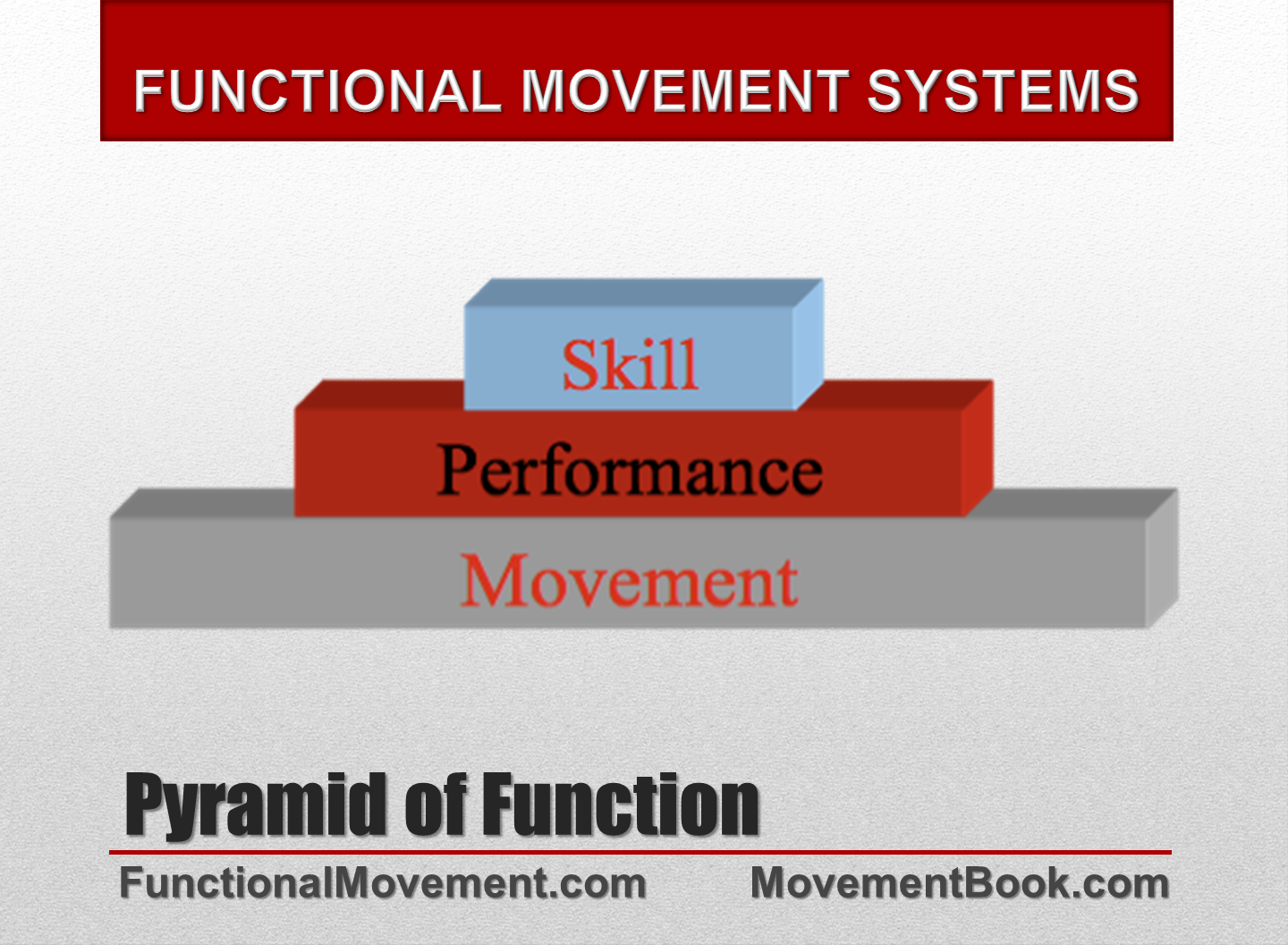
Hello everybody! I’ve previously mentioned Gray Cook and some of his thoughts on how the body moves. Today I am going to discuss how his thoughts mixed with those of Douglas Heel relate to cueing a movement. One thing Gray Cook includes in his FMS program is a pyramid that looks like this: His ideas are that we need to install quality movement before reinforcing that movement by increasing performance. Finally once we have a solid base we can properly teach (sport) skill. After I saw this pyramid, I instantly thought about Douglas Heel’s three body zones presented in his Be Activated series. I created a similar pyramid with Heel’s zones, which looked like this: Notice any similarities? These two pyramids are almost talking about the same thing but from two different approaches. Quality movement begins with zone 1. Power (performance) is produced in zone 2, and skill exists in zone 3. This progression also mimics the relationship between a sport coach, strength coach, and the...

Cookie Cutter Protocols

Image
Hello Everybody! I’d like to discuss one basic treatment philosophy today; cookie cutter protocols. What role, if any, do they play in our treatments? I’ll start by saying in an ideal setting I would prefer to assess every athlete’s health and quality of movement then address not only the injured tissue but any imbalances they may have as means of injury prevention. Unfortunately this is rarely feasible due to time constraints as I’m sure many of you can relate. It’s my impression that cookie cutter protocols often get a bad reputation as being unspecific and impersonal, but is there some sense to using them? First let’s get on the same page and define what a “cookie cutter” protocol looks like. I consider a cookie cutter protocol to be a “one size fits all” type of rehab. It doesn’t matter what sport/position you play, if you suffer a lateral ankle sprain you will complete exercises XYZ over the next 2-4 weeks. Second, we should make a distinction between macro-protocols and micr...

Great Compensators

Image
Happy New Year! I hope you all got a chance to enjoy the holidays with family and loved ones. After my article on compensation patterns I began thinking more about how the body completes movement goals. Many experts will say that athletes’ are great compensators. At first I debated that statement, I thought the exact opposite. I thought athletes’ were individuals who didn’t need to compensate. But then in my personal experience of treating athletes I started to pay attention to how many soft tissue dysfunctions were a result from or somehow related to compensation patterns. Just today I treated an athlete who reported low back pain every time he ran over the past two weeks. He was evaluated by a different therapist to have low back instability, however I thought his issue was more related to a compensation pattern. So his treatment with me consisted of training him to revert out of his hip extension compensation and force him to fire his glutes more. He walked out of the athletic ...

Theories on Movement

Image
Hello Everybody! In this SOAP Note, I’d like to just offer up my thoughts on the human body. I’ve tried to research and understand as many different interpretations of the body and movement as I can find. In doing so, I have collected in this article many of what I consider to be the most effective philosophies regarding the body. Some of those who have influenced my understanding include; Tom Myers, Gray Cook, Mike Reinold, Douglas Heel, Kelly Starrett, and Mike Boyle just to name a few. I’m sure you recognize some of those names if not all of them, and if any are unfamiliar to you I would encourage you to check them out. I don’t want to use this article to just describe the theories presented by all of these brilliant men, instead I am going to talk about some of the similarities I have found or adaptations I use. A mentor of mine from my days as an undergrad AT student once told me that mobility = flexibility + strength. In other words, range of motion (flexibility) requires co...